Delos Tour from Mykonos
A visit to Delos is one of the most rewarding day trips from Mykonos, combining mythology, archaeology, and history on one of the Mediterranean’s most important ancient sites.
Explore the ancient city with a certified guide and return boat travel. Discover English guided Delos trip ↗
Delos is a 30-40 minute boat ride from Mykonos old port and one of the most significant archaeological sites in the entire Mediterranean: the mythological birthplace of Apollo, a UNESCO World Heritage Site, and a former city of up to 30,000 people abandoned for two millennia. Entry costs €20 per adult, the return ferry from Mykonos costs €25, and the site is open April through October. Go with a licensed guide: the ruins require context to read properly. Take the earliest ferry, bring far more water than you think you need, wear proper shoes, and bring cash. This is not an optional addition to a Mykonos trip. It is one of the best things to do in the Cyclades.
| Distance from Mykonos | ~10km (6 miles) southwest |
| Ferry crossing time | 30-40 minutes from old port |
| Return ferry cost | €25 (€12 children 6-12, under 6 free) |
| Site entry fee | €20 adults, €10 concession (paid on Delos, cash preferred) |
| Opening hours (summer) | 08:00-20:00 (April-October) |
| Opening hours (November) | 08:00-16:00 |
| December-March | Closed to general visitors; pre-booked visits only |
| Ferry departures from Mykonos | Typically 09:00, 10:00, 11:30 (check old port board daily) |
| Ferry returns from Delos | Typically 12:00, 13:30, 15:00 (and 19:30 in peak season) |
| UNESCO listing | World Heritage Site since 1990 |
| Recommended time on site | 2-4 hours minimum |
| Guided tour price | €79-120 per adult (including ferry, entry, guide) |
Booking choice: 4 hours • Select the English tour • Old Port check-in 60–30 minutes before departure. Site and museum admission extra; hotel pickup excluded. Uneven terrain. Check dates for English guided Delos trip ↗
What Is Delos and Why Should You Visit?
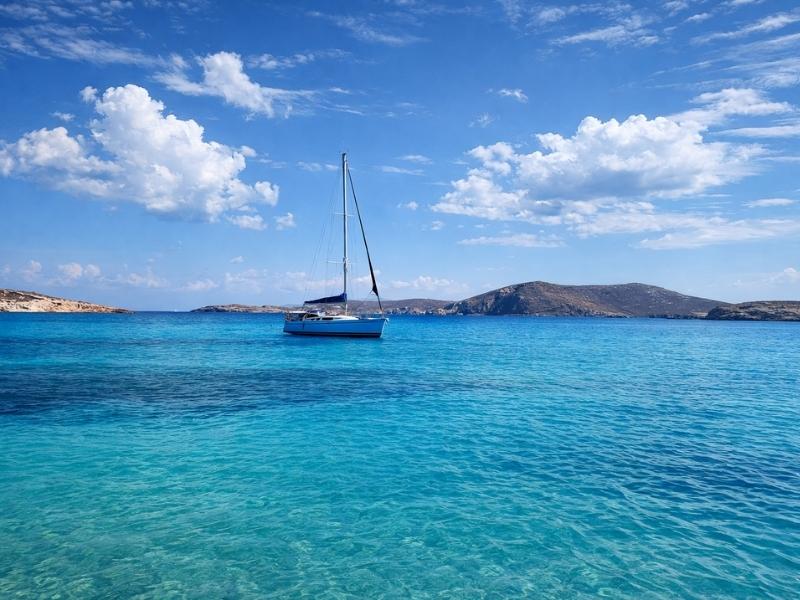
Delos is a 3.4 square kilometer uninhabited island six miles southwest of Mykonos, a UNESCO World Heritage Site since 1990, and one of the most significant archaeological sites in the entire Mediterranean. In antiquity it was the mythological birthplace of Apollo and Artemis, a Panhellenic religious sanctuary, and at its peak a cosmopolitan city of up to 30,000 people drawing merchants, pilgrims, and settlers from across the ancient world. It was abandoned after 69 BCE and never reoccupied. What remains is two millennia of undisturbed archaeology.
The significance of Delos in the ancient world is genuinely difficult to overstate. From its recognition as Apollo’s birthplace, the island became the spiritual center of the Cyclades and a pilgrimage destination for Greeks from across the Mediterranean. Myth held that the island was anchored into place by Poseidon specifically to give Leto, escaping the wrath of Hera, a fixed ground on which to give birth to her twins. The name Delos means “visible” or “apparent” in ancient Greek, a reference to the island surfacing from the sea for this purpose. Before being named Delos it was called Ortygia, or Adelos, meaning “the invisible.”
In 167 BCE, Rome declared Delos a free port, removing all trade duties. The result was an explosion of commercial activity that transformed the already-sacred island into the busiest trading hub in the eastern Mediterranean. Greeks, Romans, Syrians, Egyptians, Phoenicians, and Italians all maintained permanent presences. The wealthy built houses with mosaic floors and frescoed walls. Temples to a dozen deities stood alongside warehouses and markets. Roman Senator Publius Festus described Delos in the second century AD as the “greatest commercial center of the whole world.” Then, in 88 BCE, the Pontic king Mithridates sent an army that killed 20,000 people on the island in a single day. A second sack followed in 69 BCE. Delos never recovered and was gradually abandoned.
What this history means for a visitor today: you are walking through an ancient city that was simply left. No one built over it. No medieval town sits on top of it. The excavations, which began with the French School of Archaeology in 1873 and continue today, have uncovered temples, marketplaces, residential streets, theatres, and floor mosaics in a state of preservation that rivals Pompeii. The island is entirely an archaeological site. There are no hotels, no permanent residents, no shops beyond a small museum cafe. It is barren and bright and astonishing.
There is also an urgent reason to go now. Recent findings presented to the Academy of Athens confirm that Delos is sinking at approximately one centimeter per year due to rising sea levels and the island’s geological composition. Some of the lower-lying structures are at increasing risk. This is a site that will look different in thirty years than it does today.
How Do You Get to Delos from Mykonos?
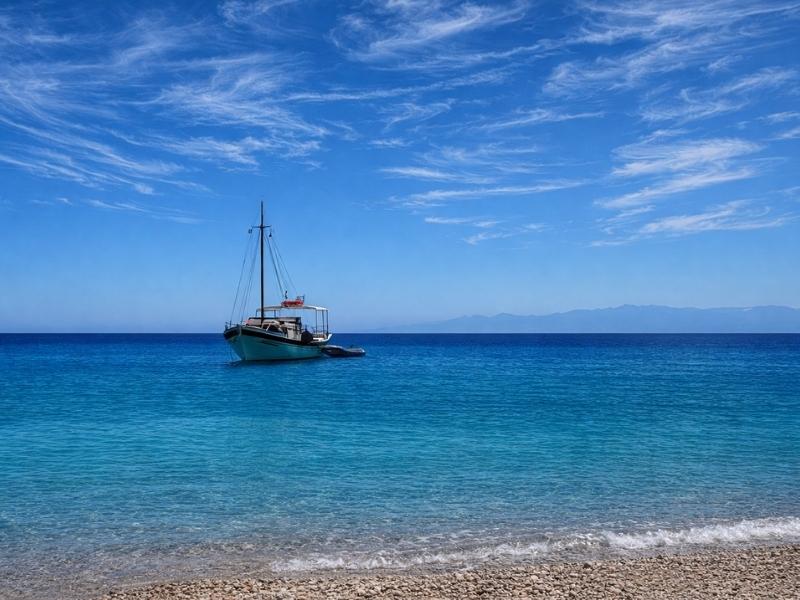
By boat from the old port in Mykonos Town. Public ferries run daily from April through October, with departures typically at 09:00, 10:00, and 11:30. The crossing takes 30-40 minutes. Return ferries leave Delos at approximately 12:00, 13:30, 15:00, and 19:30 in peak season. Always check the chalkboard at the old port ticket booth on the morning of your visit, as schedules shift in response to wind conditions and demand.
The departure point is the old port in Mykonos Town, near the Little Venice waterfront, not the new port at Tourlos where large ferries dock. The ticket booth sits beside the boats at the old port. Return tickets cost €25 for adults, €12 for children aged 6-12, and free for under-sixes. This covers the boat crossing only and does not include site entry, which is paid separately on Delos at €20 per adult.
Buying your ferry ticket online in advance for a small booking fee is worth doing in peak season. The 09:00 and 10:00 departures fill quickly on busy July and August mornings, and arriving at the ticket booth to find the morning boats sold out wastes time and pushes you into the hotter, more crowded midday slot. Ferryhopper handles online booking for the Mykonos-Delos crossing with a €4 booking fee and free cancellation up to 24 hours before departure.
Private boats are not permitted to land at Delos independently. The island operates under the jurisdiction of the Greek Ministry of Culture and access is controlled. All visitors arrive via the official ferry service or as part of an organized tour operating under the requisite permits. Organized catamaran and sailing tours that include Delos as part of a day trip typically have their own arrangements.
Getting to the old port from your accommodation: from Chora it is a short walk. From Ornos, Psarou, or other south coast beaches, take the public bus to Fabrika square and walk to the waterfront, or arrange a taxi in advance. The old port is walkable from most central Mykonos Town accommodation.
Planning a Mykonos trip involves more moving parts than most Greek island holidays – our how to plan a trip to Mykonos tours guide breaks down the booking timeline, transport options, and what to sort out before it’s too late.
What Does the Delos Archaeological Site Look Like?
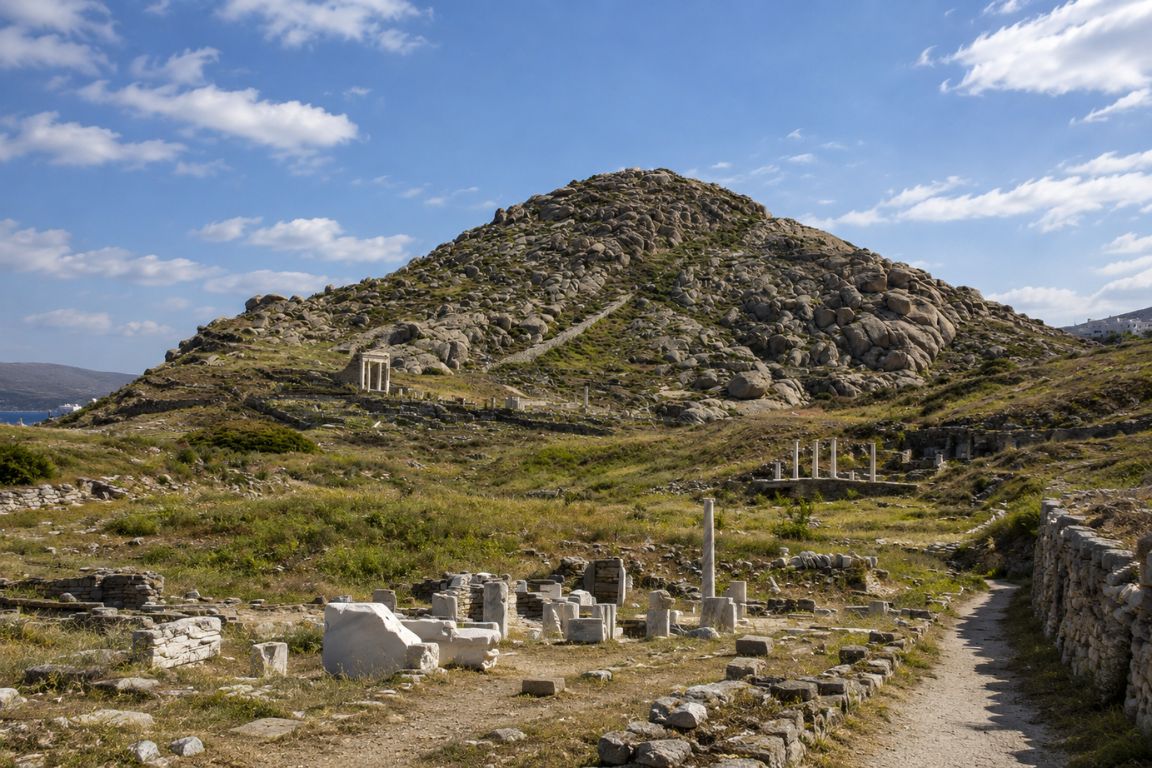
 Walking Delos is walking through a city that has been empty for two thousand years. The site covers the northwestern part of the island and divides into four main zones: the Sacred Precinct of Apollo with its temples and sanctuaries, the residential Theatre Quarter with its extraordinary mosaic-floored houses, the area of the Sacred Lake and the Terrace of the Lions, and Mount Kynthos at the island’s high point. A thorough visit takes two to four hours on foot across uneven rocky terrain in full sun.
From the dock, the Sacred Way leads directly inland toward the Sanctuary of Apollo. This was the religious heart of the island for centuries: three temples to Apollo stand in sequence along the processional route, each built at a different period of the island’s history. Little of the original standing height remains, but the foundations, column drums, and architectural fragments are extensive. The colossal statue of Apollo that once stood here survives only as fragments, including a hand and part of a knee, now in the Delos museum. The scale of the original hand, roughly the size of a crouching adult, communicates what the full statue must have looked like.
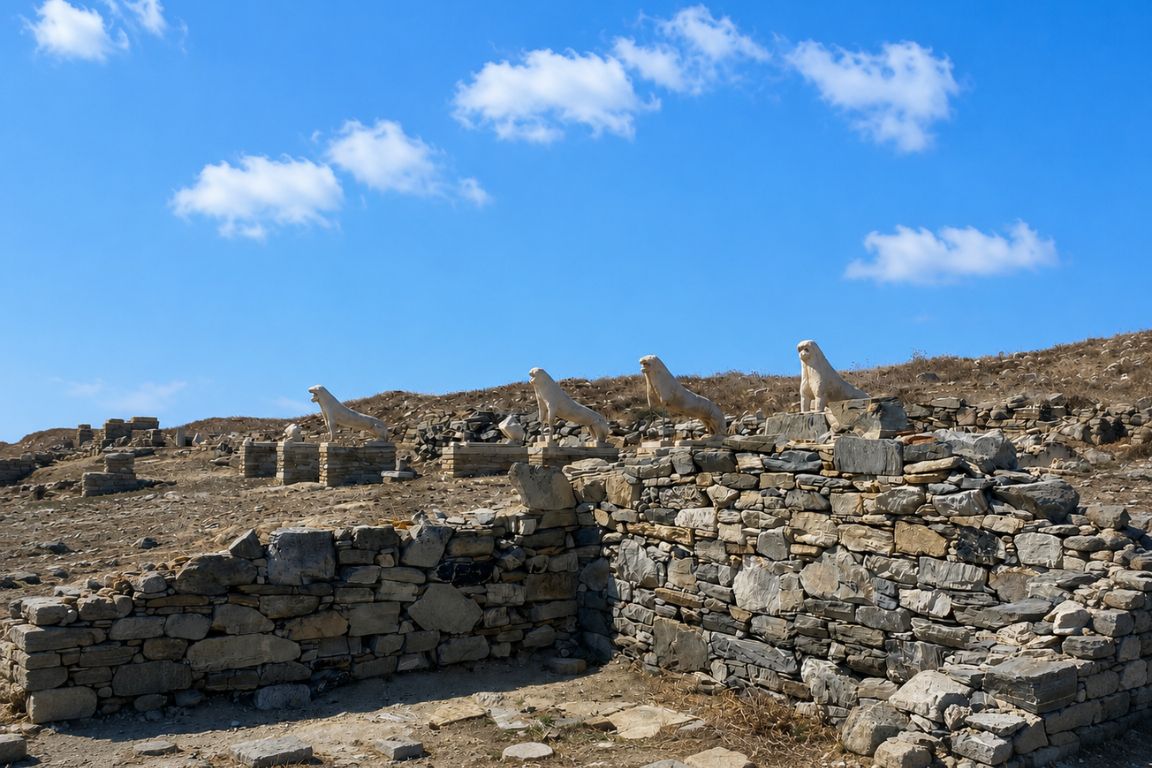
The Terrace of the Lions is the image most people carry from Delos. Carved in the 7th century BCE by the people of Naxos from their own island’s marble, the lions were dedicated to Apollo as guardians of the Sacred Lake, which lies opposite them. Originally there were nine to twelve, possibly as many as sixteen. Today seven remain on the terrace, five of which are replicas placed when the originals were moved to the museum for preservation. One was removed centuries ago by Venetians and now stands in Venice. The lions are worn by two and a half millennia of Aegean wind, their features softened rather than erased, still facing out across what was once the sacred water. The Sacred Lake itself was drained in 1925 as a malaria-prevention measure. A small grove of palms marks where it stood.
The Theatre Quarter is where the wealth of Delos’s commercial peak is most visible. The streets here are paved with slate slabs. Houses rise to five meters or more, some with their second stories partially intact. The private courtyards of wealthy merchants are lined with columns, and the mosaic floors beneath them are among the finest surviving examples of Hellenistic floor art in Greece. The House of Dionysus contains the island’s most famous mosaic: the god riding a panther, the colors holding after two thousand years in the open air under a protective structure. The adjacent House of Masks and House of Dolphins contain comparable works of equal quality. Walking these residential streets with a guide who can explain which merchant lived where, what goods they traded, and why they built their houses in this particular configuration turns the ruins into something genuinely human.
The Theatre itself seated around 5,500 spectators and is largely intact. Beside it lies the underground cistern that stored the island’s water supply: Delos has no freshwater springs, and the entire population depended on rainfall captured and stored in a network of cisterns across the island. The cistern beneath the theatre is visible through a grating and gives a clear sense of the engineering required to support a city on a barren Aegean rock.
Mount Kynthos at 113 meters is the island’s high point and requires a climb along a stepped path that takes twenty to thirty minutes. At the summit, the view encompasses the entire Cyclades: Mykonos to the northeast, Tinos to the north, Paros and Naxos to the south, the outline of Syros to the west. On the ascent, the Sanctuary of the Foreign Gods is worth pausing at: temples to Isis, Serapis, and other non-Greek deities whose worshippers settled on Delos during its cosmopolitan commercial peak. The Kynthos Cave near the summit is a man-made granite structure that once housed a statue of Heracles. The wind at the top is significant, particularly in July and August when the meltemi is at strength. Secure your hat before you climb.
The Archaeological Museum of Delos sits within the site and houses the original Lions, among hundreds of other finds: statues, friezes, pottery, the fragments of the colossal Apollo, Hellenistic mosaics removed from houses for preservation, and everyday objects that put the abstract grandeur of the temples into human scale. The museum underwent extensive renovation completed in 2024. Allow thirty to forty-five minutes for it on top of your site time.
How Much Does the Delos Tour Cost?
Going independently costs €45 per adult all in: €25 for the return ferry from Mykonos and €20 for site entry, paid at the ticket office on Delos. A guided tour with a licensed archaeologist, including ferry, entry, and guide, runs €79-120 per adult depending on group size and operator. A combined Delos and Rhenia catamaran tour, adding swimming at Rhenia and lunch on board, runs €90-140 per person and represents the most complete single-day experience.
The cost breakdown is simple. None of the prices are negotiable and entry must be paid on site in cash or by card at the Delos ticket office. There are no discounts for showing up without booking, and there are no combination tickets that include both the ferry and site entry. They are purchased separately: the ferry at the Mykonos old port, the entry at the gate on Delos.
| Public ferry (DIY) | Ferry only (entry paid separately on Delos) | €25 ferry + €20 entry = €45 | Experienced archaeology visitors, researchers |
| Guided half-day tour | Ferry, entry, licensed guide (2-3 hrs on site) | €79-100 | Most first-time visitors |
| Private guided tour | Ferry, entry, private licensed guide, flexible timing | €100-120+ pp depending on group size | Families, serious history enthusiasts |
| Delos and Rhenia catamaran | Catamaran, Delos guided visit, Rhenia swimming, lunch, drinks | €90-140 | First-timers wanting history plus beach day |
Children aged 6-12 pay €12 for the ferry and €10 for reduced entry. Under-sixes travel free and have no entry charge. The site is not stroller-friendly due to rocky terrain and uneven paths, though families with young children do visit successfully.
Not sure whether visiting Mykonos on a tight budget is even realistic or whether the island is genuinely only for travellers with money to burn? Check out our Mykonos tours on a budget guide before you write it off entirely.
Should You Go to Delos with a Guide or on Your Own?
Go with a guide if this is your first visit. The honest case for this: Delos has almost no explanatory panels in English on site. The ruins are extensive and, without context, a significant portion of what you are looking at reads as ancient rubble rather than a city. A licensed archaeologist-guide transforms the experience from a walk through ruins into a walk through a city you can mentally inhabit. The case for going independently is valid only if you have genuine background knowledge of ancient Greek history and architecture or are prepared to research the site thoroughly in advance.
The most common Tripadvisor pattern for Delos is illuminating: visitors who went independently frequently write that they wished they had a guide. Visitors who went with a guide almost never say they regret the extra cost. The site covers a large area under full sun, there are no information panels at most structures, and the layout is not intuitive without knowing the city’s historical organization. The Terrace of the Lions is immediately legible because it is visually dramatic. The temples of Apollo, the residential quarter, the foreign sanctuaries on Kynthos: these require explanation to reveal their significance.
The format of the guided tour matters as much as the presence of a guide. Large group tours of forty or more passengers herded off a tour boat represent the worst version: a guide using a microphone in the wind, difficult to hear, impossible to ask questions. Small group tours of eight to sixteen, departing from the old port in the morning, with a licensed archaeologist who knows the site well, represent the best version. The difference in experience is significant. When booking a guided tour, check the maximum group size and confirm the guide’s credentials. The Delos Experience operation offers structured daily guided tours with archaeologist guides departing from the old port at 10:00am, with a second departure at 17:00pm from May. These are a reliable starting point.
Audio guides downloaded to a smartphone represent a middle path: more context than going completely independent, more flexibility than a group tour with fixed timing. A self-guided audio tour app covers the main site checkpoints and is a reasonable option for travelers who know they will want to move at their own pace and spend more time at specific structures. The combination of an audio guide and a good printed map, purchased at the ticket booth, is adequate for visitors with a genuine interest in ancient history who are willing to invest preparation time.
Mykonos boat parties vary wildly in terms of crowd, music, boat quality, and what’s actually included in the price – our Mykonos boat party guide breaks down what separates a genuinely good experience from an overcrowded disappointment on the water.
What Are the Best Delos Tours from Mykonos?
 The best Delos tour for most first-time visitors is a small-group guided half-day tour departing on the 09:00 or 10:00 ferry, with a licensed archaeologist guide, capped at no more than sixteen passengers. This format puts you on site before the midday heat and the largest crowds, gives you proper context for what you are seeing, and leaves the afternoon free. For travelers who want to combine Delos with swimming at Rhenia, a full-day Delos and Rhenia catamaran tour is the most complete option.
The Delos Experience guided tours operate daily from the old port at 10:00am (English) and at 17:00pm from May onward. These are purpose-built Delos tours led by licensed archaeologists and represent the most focused guided option available. Group size varies by date; morning tours are typically smaller. At €79 per adult including ferry and entry, they are the benchmark for the guided format.
For the combined Delos and Rhenia day: catamaran operators departing from Ornos include Delos as part of a full-day sailing tour, with the catamaran anchoring offshore for a view of the site or allowing a landing stop, then continuing to Rhenia for swimming and on-board lunch. This format works well for travelers who want the Delos visit to be one element of a broader sea day rather than the sole focus. The trade-off is that the time on Delos itself is typically shorter than on a dedicated guided tour, and the guide on a catamaran tour is the captain rather than a specialist archaeologist.
For travelers who want private access with full timing flexibility: a private guided tour with a licensed archaeologist, booked directly or through a tour operator, allows you to arrive on the earliest ferry, spend four hours on site rather than the standard two, linger at the mosaics, climb Kynthos, and leave on the ferry of your choosing. This format is best for serious history enthusiasts and families with older children who want depth rather than a highlights overview.
Want to make sure your first Mykonos trip covers the highlights without the rookie mistakes that most first-timers only regret in hindsight? Here’s our Mykonos tours for first-time visitors guide so you get it right from the start.
What Should You Know Before Visiting Delos?
Six things that most Delos visitors wish they had known before arriving: the site has no shade, no shops, and no potable water; entry must be paid in cash or card on the island and is not included in ferry tickets; proper closed-toe shoes are essential for the rocky terrain; the earliest ferry puts you on site before the worst heat and the largest crowds; meltemi wind can affect ferry schedules in July and August; and the museum on site is the single most important stop that most visitors shortchange or skip entirely.
Water. This cannot be overstated. Delos is a barren granite island in the Aegean, treeless and shadeless, with the sun reflecting off white stone from every direction. The site cafe near the museum sells water but at limited volume and at peak-season prices. Bring an insulated bottle filled before departure with at least a liter per person, more in July and August, more still if you plan to climb Kynthos. Visitors who ran out of water on site and were forced to pay cafe prices or cut the visit short is one of the most consistent fail-point patterns we see.
Shoes. The paths on Delos range from paved ancient marble to loose rocky rubble. Flip-flops are the wrong choice. A sandal with a firm sole and ankle support, or closed-toe shoes, handles the terrain without the ankle-roll risk that flat beach footwear creates on uneven ancient paving. The ascent of Kynthos is particularly rough underfoot near the summit.
Timing. The first ferry at 09:00 puts you on site before the midday heat peaks and before the bulk of the day’s visitors arrive. By 11:30, the most popular sections of the site, particularly the Terrace of the Lions and the House of Dionysus, are noticeably more crowded. The late afternoon departure at 17:00 (available from May) is a less crowded alternative with extraordinary light quality for photography, but allows only two hours on site before the last return ferry.
The museum. A majority of visitors spend all their site time on the ruins and walk past the museum or skip it as they head for the return ferry. This is the wrong call. The original Lions are in the museum, not on the terrace outside. The mosaic fragments, statues, and everyday objects collected here give the ruins outside a scale and a humanity that standing in front of the empty temples cannot. Budget forty-five minutes for it at minimum, and plan your ferry return around having the time.
Meltemi and cancellations. In peak meltemi conditions in July and August, the Mykonos-Delos ferry can be delayed or cancelled. Check the conditions and the old port board on the morning of your planned visit. If strong winds are forecast, prioritize an early departure on the first available boat. Tours that operate their own vessels have more flexibility on timing than the public ferry.
Cash. The Delos entry ticket office accepts card but cash is more reliable and avoids queuing issues when the card reader is busy. The cafe accepts card. Bring €20 per adult in cash as a minimum to cover entry without any uncertainty.
Not sure when to go to get the best of Mykonos without the worst of the summer crowds and peak season prices? Here’s our best time to visit Mykonos tours guide so you time your trip right.
| Skipped Delos entirely | Very common, often regretted | Build it into day 2 or 3 before other priorities crowd it out |
| Went without a guide | Common | Frequently wish they had booked a guided tour |
| Ran out of water on site | Common in July and August | Bring minimum 1.5 liters per person from Mykonos |
| Arrived midday on late ferry | Moderate | Take the 09:00 or 10:00 boat, not the 11:30 |
| Skipped the museum | Very common | Budget 45 minutes minimum; the original Lions are in there |
| Wore flip-flops on rocky terrain | Common | Closed-toe shoes or firm-soled sandals only |
| Climbed Kynthos and found it worth it | Universal among those who attempted it | Plan the extra 30 minutes, go early before the heat peaks |
Frequently Asked Questions
Is the Delos tour from Mykonos worth it?
Yes, without qualification. Delos is one of the best-preserved ancient sites in the Aegean and one of the most historically significant in the entire Mediterranean. It is 30 minutes from Mykonos by boat. The travelers who skip it most often say afterward it was their biggest regret of the trip. It costs €45 independently or €79-140 on a guided tour. For what you get, it is exceptional value by any standard.
How long does the Delos tour take?
Allow a minimum of two hours on site for a highlights visit. Three to four hours covers the site thoroughly including the museum. Adding the climb to Mount Kynthos adds thirty to forty minutes. The public ferry schedule typically gives you a two to three hour window on site depending on which departure and return times you choose. Guided tours run two to two and a half hours structured time, with some free time at the end for the museum.
How do you get to Delos from Mykonos?
By public ferry from the old port in Mykonos Town. Departures typically at 09:00, 10:00, and 11:30 from April through October. Return ferries at approximately 12:00, 13:30, and 15:00. The crossing takes 30-40 minutes. Check the chalkboard at the old port ticket booth on the morning of your visit for that day’s exact times. Buy tickets in advance online during peak season to secure your preferred departure.
What should I wear to Delos?
Closed-toe shoes or firm-soled sandals with ankle support, not flip-flops. The terrain is rocky and uneven, particularly on the ascent to Kynthos. A hat is essential: the island is completely exposed with no tree cover. Light clothing that covers shoulders reduces sunburn risk significantly. Bring your own sunscreen applied before arrival rather than relying on applying it on site.
Can you visit Delos without a guided tour?
Yes. The public ferry drops you at the dock and you can explore independently using a map from the ticket booth. The case against going without a guide: the site has almost no English explanatory panels. The ruins are extensive and require context to understand properly. Most first-time visitors who go independently finish the visit with a sense that they saw something impressive but could not fully read what they were looking at. A guide resolves this completely.
What is there to see at Delos?
The Terrace of the Lions (7th century BCE marble guardians of the Sacred Lake), the Sanctuary of Apollo with three ancient temples, the Theatre Quarter with exceptional Hellenistic mosaic floors in the House of Dionysus and House of Masks, the ancient marble theatre seating 5,500, Mount Kynthos with Cycladic panorama views, the Sanctuary of the Foreign Gods, and the Archaeological Museum of Delos housing the original Lions and hundreds of other finds. A thorough visit covers all of these in three to four hours.
Greek tour guide since 2012 · Founder, Mykonos Tours
Alexandros has guided over 13,500 travelers through Mykonos and the Cyclades since founding the agency.
Your next step · optional experience
Choose how to visit Delos
General recommendation — choose an option below to refine it.
Delos guided ferry trip
Check your date before arranging the rest of your day. Explore the ancient city with a certified guide and return boat travel.
4 hours • Select the English tour • Old Port check-in 60–30 minutes before departure. Site and museum admission extra; hotel pickup excluded. Uneven terrain.
Choose a date to view the published departure schedule. Final availability and price are confirmed on Viator.
Compare options, fit your day or calculate the cost
Explore the ancient city with a certified guide and return boat travel. 4 hours • Select the English tour • Old Port check-in 60–30 minutes before departure. Site and museum admission extra; hotel pickup excluded. Uneven terrain.
Swim at Rhenia, eat lunch aboard and explore Delos in one 5–6-hour outing. Choose the live English guide option for guided Delos. Admission and optional pickup cost extra. Confirm meeting point the day before; swimming uses a ladder.
Connect from New Port by SeaBus, then take the ferry to a guided Delos visit. 5 hours • Choose English • Meet at the SeaBus stop; no hotel pickup. Confirm entrance-fee treatment in the selected option. Not wheelchair suitable.
We may earn a commission from bookings through these links. Your final price and booking conditions are shown by the provider.